Company Insight
Sponsored by Mimotopes
The Peptide Technologies Enabling Today’s Most Sophisticated Immunotherapies
Cancer immunotherapy has already reshaped oncology once, but it is now entering a far more complex and sophisticated chapter.
Main image credit: National Cancer Institute via Unsplash
The first generation of treatments, led by checkpoint inhibitors, demonstrated the immense power of harnessing the immune system. Today, researchers are pushing beyond those initial breakthroughs with novel cell therapies, bispecific molecules, advanced delivery systems and AI-guided targeting strategies are accelerating the field into a new era of precision, versatility and personalisation.
Amid these shifts, peptides—long regarded as a powerful but niche tool—are emerging as one of the most adaptable platforms in the immunotherapy developer’s toolbox. Their ability to combine the precision of biologics with the tunability of small-molecule drugs is making them central to next-generation therapies. And companies such as Mimotopes, with decades of peptide design, synthesis and library expertise, are increasingly pivotal partners in this field.
Evolving Immunotherapies
The evolution of cancer immunotherapy can be understood through a handful of major trends now shaping the field.
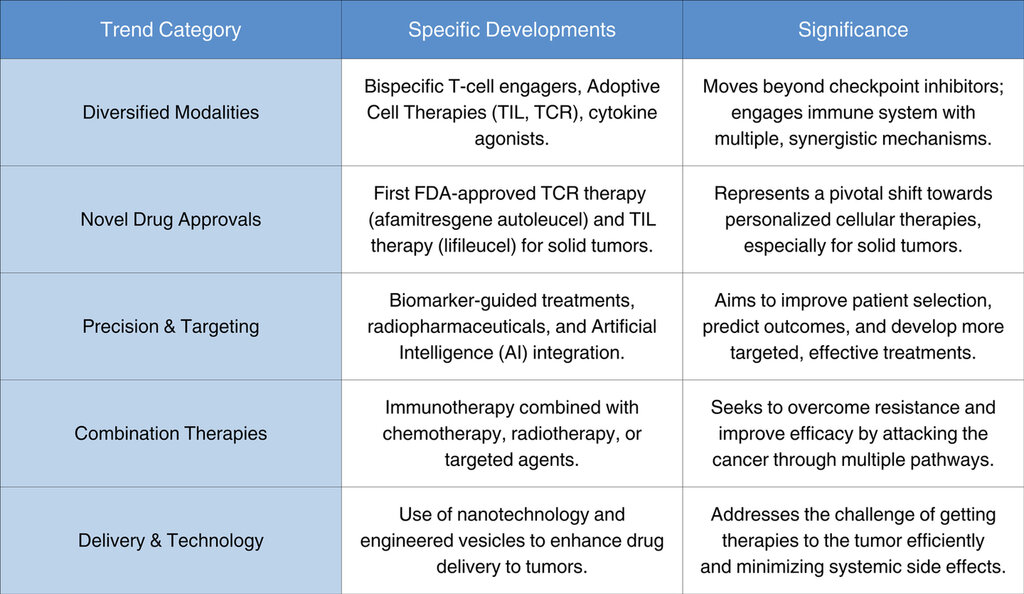
Researchers are diversifying treatment modalities, exploring everything from bispecific T-cell engagers and cytokine agonists to adoptive cell therapies such as TILs and TCR-based treatments. The recent FDA approvals of the first TIL therapy (lifileucel) and TCR therapy (afamitresgene autoleucel) for solid tumours illustrate just how quickly this area is expanding.
A similar acceleration is unfolding in precision-driven treatments. Biomarker-guided approaches, radiopharmaceuticals and AI-assisted prediction tools are improving patient selection, sharpening therapeutic targets and reducing the trial-and-error phase of immunotherapy design. Combination therapies—pairing immunotherapy with chemotherapy, radiotherapy or targeted agents—are also gaining momentum as researchers aim to overcome tumour resistance through multi-pathway attack strategies.
These scientific leaps are matched by important advances in delivery technologies. Nanoparticles, engineered vesicles and other next-generation carriers are helping therapies reach tumours more efficiently while keeping systemic side effects at bay.
Across these developments, peptides appear again and again, not as a supporting actor, but as a foundational design element.
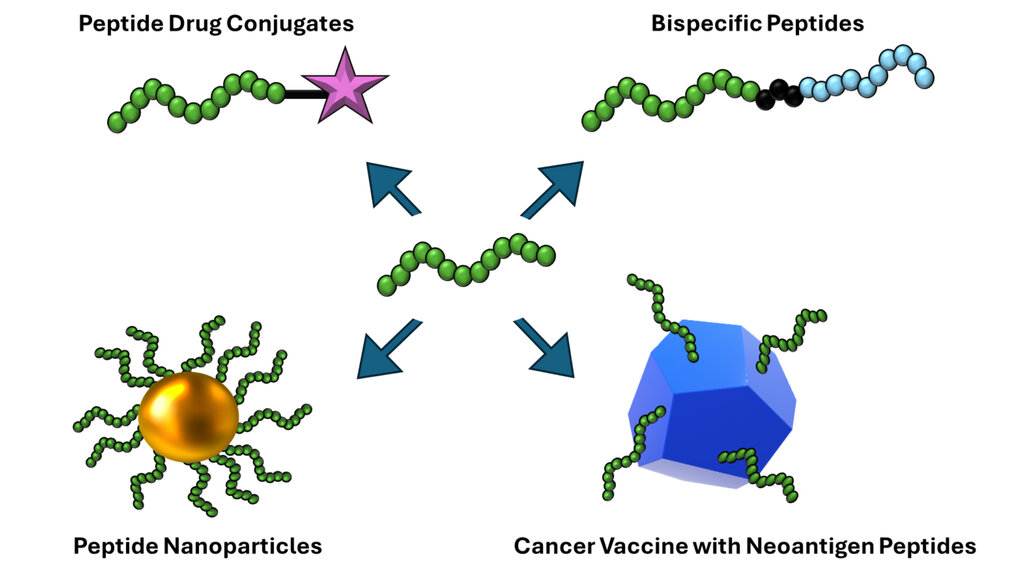
A peptide-centred view of modern immunotherapy innovation, spanning drug conjugates, bispecific constructs, nanoparticle delivery and neoantigen-based cancer vaccines.
Why Peptides Are Having Their Moment
Peptides occupy a unique middle ground where they are small enough for deep tissue penetration, but large and structured enough to achieve high target specificity. Their safety profile remains compelling too, as they break down naturally into amino acids.
Their real benefit, however, comes from their design flexibility. Peptides can be shaped, extended, stabilised, cyclised or modified with remarkable freedom, giving researchers a platform to solve multiple challenges simultaneously.
One of the clearest examples of this is the rise of peptide-drug conjugates. These “guided missiles” use a targeting peptide to direct cytotoxic payloads straight to cancer cells, sparing healthy tissues in the process. A similar logic underpins peptide-based radiopharmaceuticals, which carry lethal radiation directly into tumours.
Peptides are also driving the development of bispecific molecules: compact structures engineered to bind two targets at once. Some are designed to block two checkpoint pathways simultaneously; others serve as bridges that physically bring tumour cells and immune cells into contact, triggering an attack. Their small size compared to bispecific antibodies offers an advantage in tissue penetration, one of the keys in solid tumour treatment.
Peptide-based cancer vaccines represent another major frontier. By presenting tumour-specific neoantigens, these vaccines effectively train the immune system to recognise and destroy cancer cells. Emerging research into peptide-based vesicles suggests even greater potency in future vaccine delivery.
Finally, the stability of peptides—long a perceived limitation—is increasingly being overcome through chemical modifications such as incorporating D-amino acids, enabling peptides to persist longer in the bloodstream and resist degradation.
This is precisely where experienced peptide partners become critical.
The table below summarizes the key current trends in cancer immunotherapy.
How Mimotopes Supports the Next Generation of Immunotherapy
While the science moves at speed, the ability to design, synthesise and refine the right peptides remains a specialised craft. Mimotopes, a long-standing leader in peptide and discovery chemistry, provides the infrastructure, expertise and synthesis capabilities that researchers depend on to translate ideas from concept to clinical investigation.
The company’s custom peptide services allow scientists to develop peptides with the exact length, purity and structure required for applications ranging from targeting ligands to vaccine antigens and bispecific constructs. Their technical teams work closely with customers—whether small academic labs or multinational pharmaceutical companies—to ensure each peptide is optimised for the intended application.
Meanwhile, their PepSets™ peptide libraries give researchers rapid access to diverse peptide panels used to map bioactivity, screen binding interactions, explore epitopes or identify neoantigen candidates.
As immunotherapy developers push into increasingly complex interactions, such as dual-targeting molecules, personalised vaccine cocktails, and novel delivery systems, the ability to rapidly generate precise, high-quality peptide sequences becomes a decisive advantage.
The trajectory of cancer immunotherapy is unmistakably moving toward personalised, combination-based, multi-functional treatments. Peptides, with their adaptability and precision, are uniquely suited to power this transition. But real progress will depend on the ability to design, test and refine peptide-driven approaches quickly and reliably.
With its deep expertise and high-quality peptide solutions, Mimotopes is helping shape the future architecture of cancer immunotherapy.
Contact information
Mimotopes
Suite 1, Unit 9 / 677 Springvale Rd,
Mulgrave, VIC 3170 Australia
Tel.: +61 3 9565 1111
Email: mimotopes@mimotopes.com
Web: www.mimotopes.com

- Biffa internal savings data, average saving (January - August 2023)
- Nisbets internal savings data, average saving (January – September 2023)
- Compliance365 internal data, average savings
- HEINEKEN UK data, Calculations based on SmartDispense® active accounts each year since 2015 with 10 lines
- Independent test results based on subterranean and ground floor pub cellars of varying sizes
- Independent test results based on subterranean and ground floor pub cellars of varying sizes
