Company Insight
Sponsored by LiLiChro
What if your next preparative method did not need a silica column?
Preparative chromatography is indispensable to pharmaceutical development, but packed columns can become expensive and restrictive when samples are crude, valuable or difficult to scale. LiLiChro helps pharmaceutical teams evaluate a different option: centrifugal partition chromatography, in which both chromatographic phases are liquids.
Main video credit:

A promising compound has been synthesised. The analytical method works. The required purity is known. Yet the project slows down when the team tries to produce enough purified material.
This is where preparative purification can become a development bottleneck.
The problem is not always inadequate selectivity. It may be limited loading capacity, recurring column costs, sample loss through irreversible adsorption or a crude matrix that rapidly contaminates the stationary phase. A method that performs acceptably at milligram scale may also become difficult or uneconomical when transferred to larger batches.
For valuable APIs, intermediates, peptides, lipids and other specialist compounds, every percentage point of recovery can matter. The question is therefore not simply, “Can we separate it?” It is, “Can we recover enough product, at the required purity, using a process that can realistically be scaled?”
A different kind of chromatography
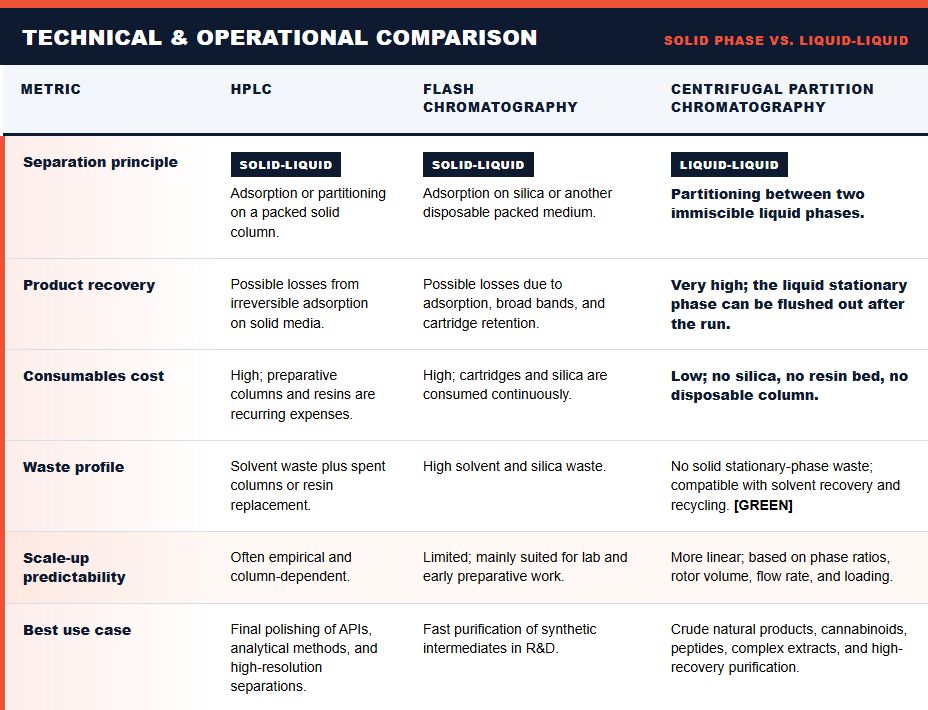
Centrifugal partition chromatography, or CPC, is a preparative liquid–liquid chromatography technique. Unlike preparative HPLC and flash chromatography, it does not use a packed silica stationary phase.
Instead, one liquid phase is retained inside a rotating cell system by centrifugal force while the second liquid phase flows through it. Compounds separate according to how they distribute between the two immiscible liquid phases.
Removing the solid stationary phase changes several practical aspects of purification. There is no silica column to replace, and suitable compounds are less exposed to irreversible binding on a solid support. Crude or complex samples that could contaminate a conventional column may therefore be worth evaluating with CPC.
CPC typically operates at relatively low pressure, approximately 5–10 bar, depending on the instrument, solvent system and flow conditions. Unlike traditional chromatography, it does not require solvent to be forced through a high-resistance particle bed. This reduces the mechanical load on pumps, seals, valves and tubing, can decrease wear and leakage risk, and simplifies pressure containment. At preparative scale, low-pressure operation can therefore reduce equipment and maintenance requirements while allowing capacity to increase without encountering the pressure limitations associated with packed stationary phases.
Caption. Credit:
CPC’s success depends on identifying a biphasic solvent system in which the target and its impurities partition differently. This is why feasibility should be established before investing significant time in method development or equipment.
Start with the compound, not the instrument
LiLiChro helps pharmaceutical teams answer the initial question:
Is CPC realistically worth testing for this purification challenge?
The process begins with a free CPC consultation assessment. Information about the target compound, sample matrix, existing method, separation challenge and required outcome is reviewed by a purification specialist. The team receives an initial go/no-go recommendation rather than a generic product presentation.
Promising cases can proceed to laboratory screening and a compound feasibility study. Candidate biphasic solvent systems are evaluated for target-compound partition coefficient, selectivity against critical impurities, phase stability, settling behaviour and sample solubility. CPC trials can then establish stationary-phase retention, practical loading, fraction purity, recovery and the operating window required for a robust preparative method.
This provides experimental evidence not only that the compound can partition between two liquid phases, but that the separation can deliver the required purity, recovery and productivity under preparative conditions.
From feasibility to production
Once a suitable CPC method has been established, the LiLiChro platform provides a continuous route from laboratory feasibility to industrial production.
MiniLiLi supports solvent-system verification, small-sample feasibility work and method development. MidiLiLi extends the same method to laboratory preparative quantities, MaxiLiLi supports pilot-scale and low-volume production, and PrepLiLi provides the capacity required for industrial implementation.
The LiLiChro platform is designed for 100% method scalability. The same biphasic solvent system, phase configuration and chromatographic separation strategy used during method development are transferred between instrument sizes. Rotor volume, flow rate, sample loading and fraction timing are scaled according to the capacity of the larger instrument, while the underlying separation method remains the same.
Caption. Credit:
This means that development teams do not need to restart chromatographic method development at every scale. Avoiding repeated solvent-system selection and scale-specific redevelopment can shorten technology transfer, reduce sample and solvent consumption, and save both development time and cost.
LiLiChro supports this process with solvent-system screening, feasibility studies and method-development assistance. Instrument training and method-development support are available both online and on-site, helping laboratory and production teams implement the method and establish suitable operating parameters on their own equipment.
If column cost, product loss, sample complexity or scale-up has become the limiting factor in your process, the next step is not necessarily another column.
It may be a five-minute assessment.
Contact information
LiLiChro
Tel.: +36 30 709 0909
Email: info@lilichro.com
Web: www.lilichro.com


- Biffa internal savings data, average saving (January - August 2023)
- Nisbets internal savings data, average saving (January – September 2023)
- Compliance365 internal data, average savings
- HEINEKEN UK data, Calculations based on SmartDispense® active accounts each year since 2015 with 10 lines
- Independent test results based on subterranean and ground floor pub cellars of varying sizes
- Independent test results based on subterranean and ground floor pub cellars of varying sizes